The boat belongs to the customer, not the shoreline
When a customer sells the cabin, the lift either goes with it or stays behind. LakeOps keeps who owns each piece, and where it is now.
· 5 min read
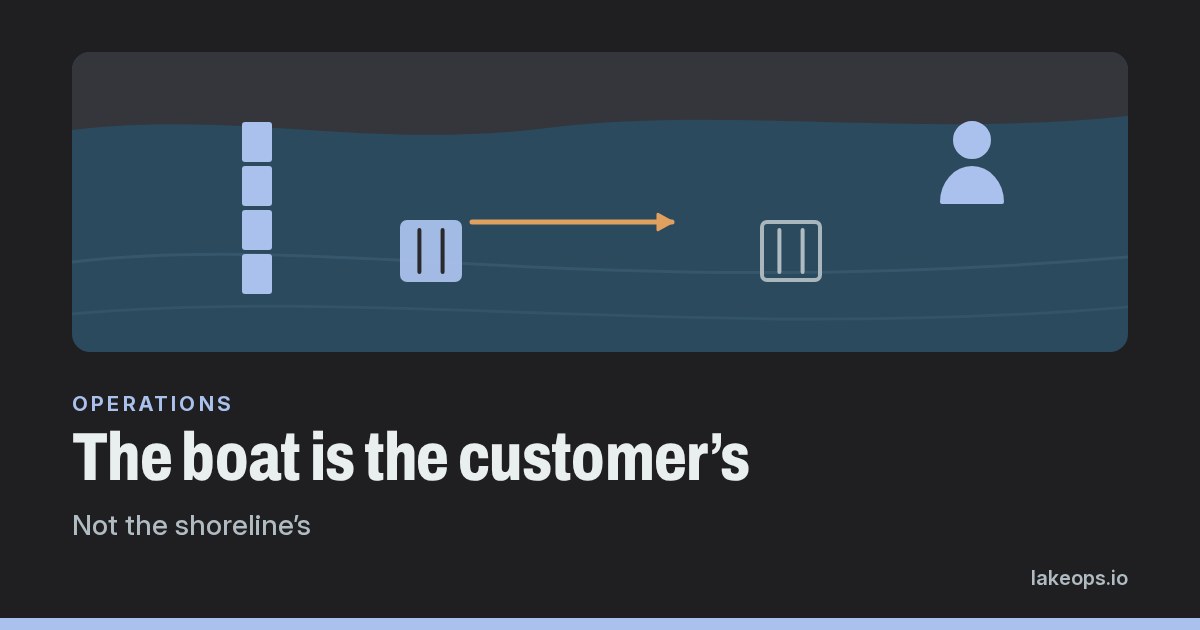
Somebody sells the cabin. The sale closes, the new owners move in, and a month later they ask where the dock went. Or the lift is still in the water, and the seller is loading it onto a trailer. Which is right? It depends on who owns the lift, not on who owns the shoreline. Most dock companies have never written that down, so the answer gets argued out at the lake.
The shoreline is land. The gear is the customer’s.
A dock, a lift or a canopy is something a customer bought and had you install. It sits on a shoreline, and the shoreline is a property. Those are two separate things. When the property changes hands, the equipment on it may go with the sale or may stay with the seller. A lift can still belong to the seller after the buyer owns the shore.
If your records treat the shoreline as the owner of everything on it, somebody gets this wrong. The buyer gets a bill for work on a lift they never bought. Or the seller’s lift stays on your schedule for next spring, on a shoreline that is no longer theirs.
Record the owner of each piece
In LakeOps every piece of equipment has one owner, a customer, and its own record of where it is. The owner is not a line under the property. When you transfer a property, the screen asks which equipment goes with it. Ticked pieces become the buyer’s. Unticked pieces stay with the seller and come off that shoreline, its plans and any open work that has not been priced or paid. A plan left with nothing on it is canceled. A job left with nothing on it is canceled if nobody has started it or sent a boat to it. Finished work stays with the customer it was done for, whatever happens to the shore.
A piece can also change hands on its own. A customer sells a boat lift to a neighbor, and the shore it sat on is not part of that sale. That is a hand-over. The piece goes to the new owner, comes off the old owner’s plans, and keeps its history.
Ownership is not location
A lift can belong to one customer and winter in your yard. So each piece also has a record of where it is now: on the customer’s shore, or in one of your places. Every move is written down, and a Move job says where the piece ends. The question “where is it” has an answer that does not depend on who owns it, and the question “who owns it” has an answer that does not depend on where it is.
What to do before the next sale closes
Go through the equipment on the shoreline first and decide who keeps each piece. The transfer screen will ask anyway, and deciding on paper beforehand is quicker than deciding in the middle of a closing.
Then look at the property’s open jobs after the transfer. A piece the seller kept is off work that was not yet priced or paid. A priced or paid job still has it on and stays the seller’s. A job that somebody started, or that a boat was sent to, stays open even when nothing is left on it, and it goes to the buyer with the shoreline unless somebody else pays for its plan. Settle those before a crew goes out. If the seller still wants that piece serviced somewhere else, set that up for them as new work.
Equipment and places · Moving equipment, and when it is sold · Adding your customers and their properties