Where the boats are
Where are they right now — without ringing the boat
The question every dock company’s office asks four times a day is the same one: where are they, and how far through. Ringing the boat to find out costs the crew a pair of gloves and you a lift. This is that question answered on a screen — and answered honestly, including when the answer is “nobody has said for twenty minutes”.
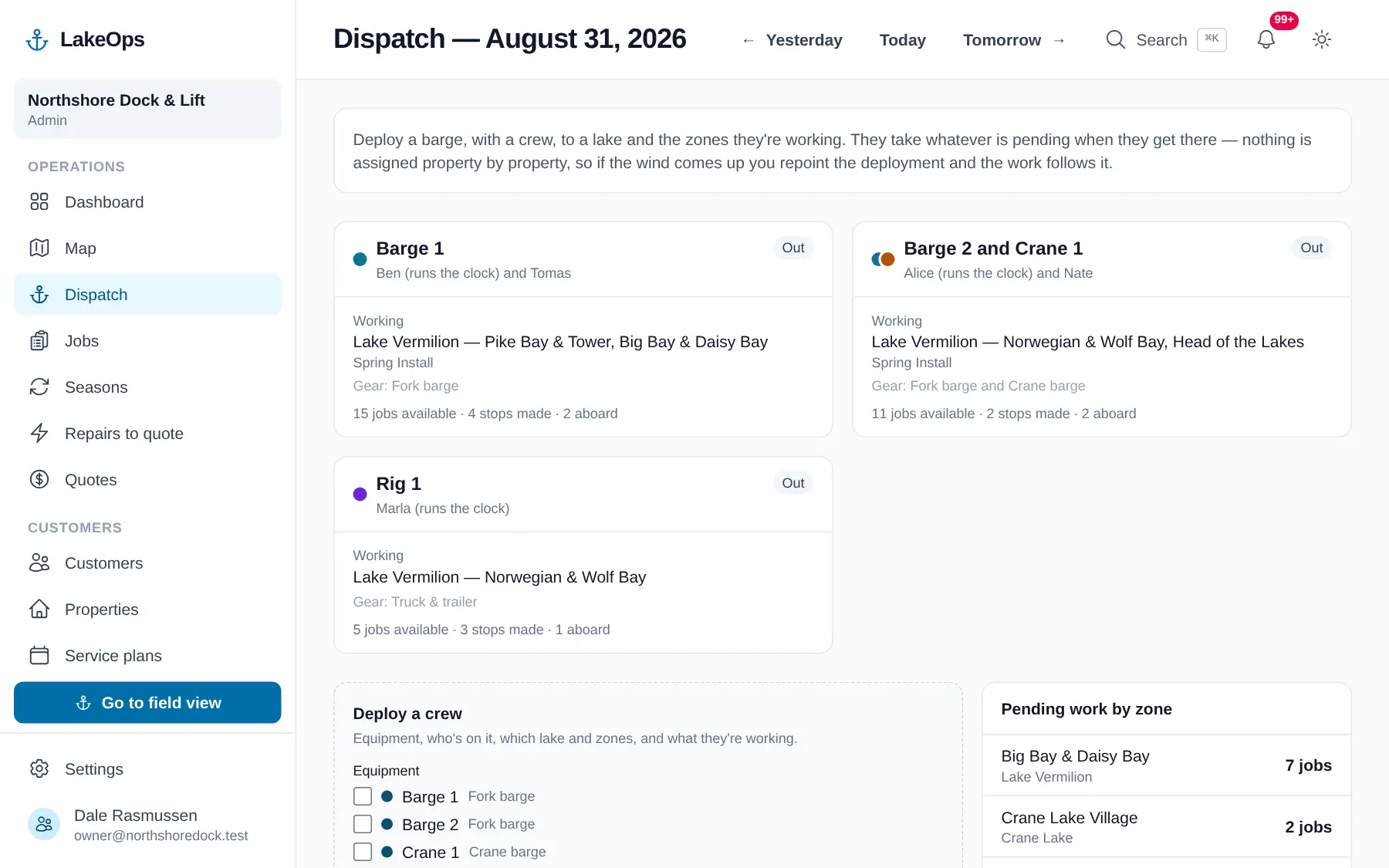
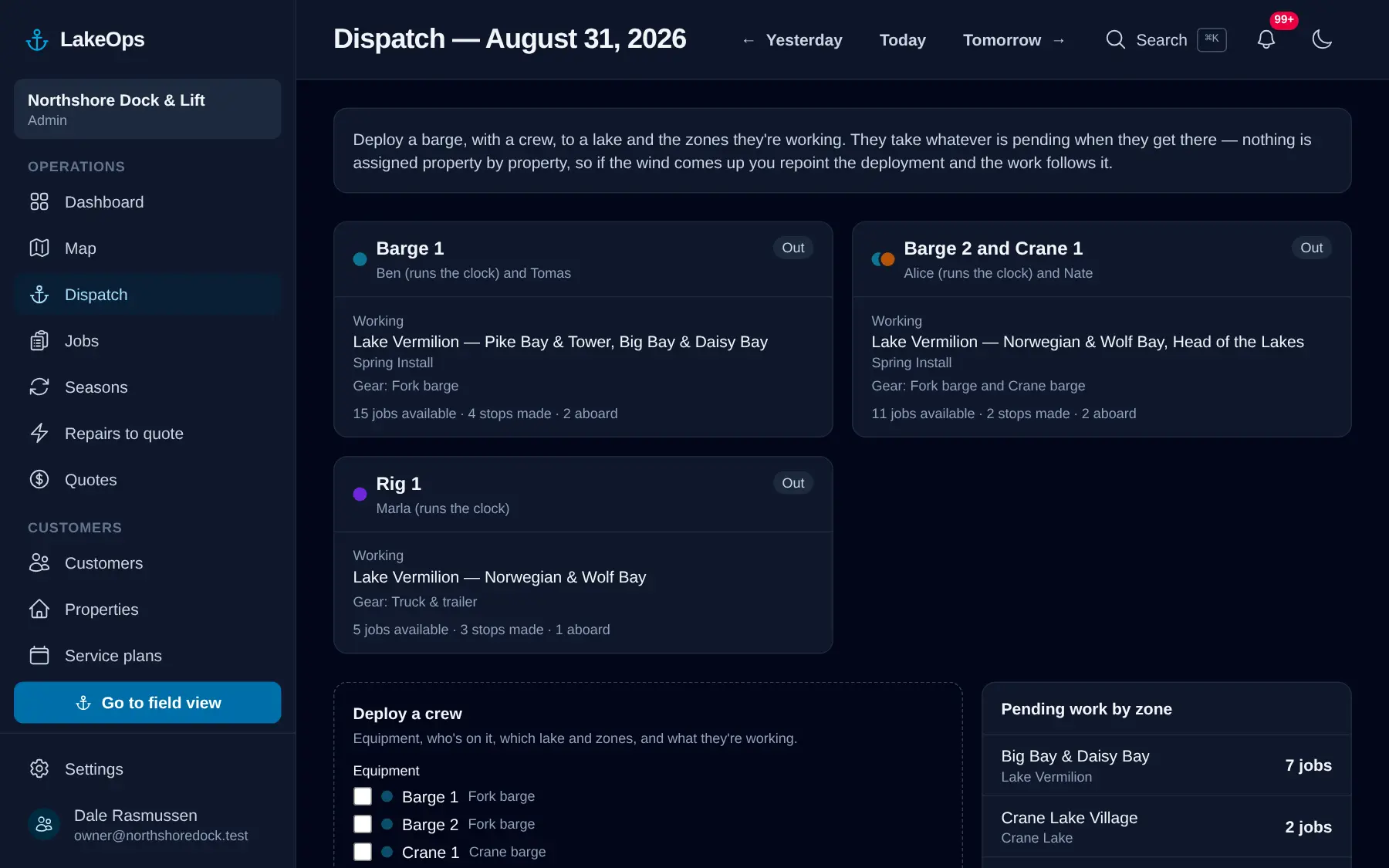
Every position says how old it is
A dot on a map with no time on it is worse than no dot, because an office acts on it. Every boat here carries its age in words — “just now”, “12 minutes ago” — and a boat that has gone quiet is shown quiet rather than dressed up as live. That is the difference between knowing where a crew is and thinking you do.
Quiet is normal, and the screen says so
A phone only reports while the crew has the app open. A hand working a lift with the phone in a pocket goes quiet for exactly as long as the job takes, and a phone in a dry bag in the rain goes quiet for the afternoon. That is not a fault and the screen does not treat it as one: it falls back to where they last started a timer, and tells you that is what it is showing.
The latest position, and nothing before it
LakeOps keeps one position per person per day out, overwritten each time — there is no trail, no history and nothing to export. Your crews can be told that plainly, because it is a property of the software rather than a promise about how you will use it. If you need to know what happened when, the timers and the piece-by-piece record already tell you, and they are about work rather than whereabouts.
It stops when the day does
Position reporting only happens for somebody who is out on a boat today. A phone left on the dashboard after the boat comes in cannot report, because there is nothing to report against — not because a rule was remembered, but because the day is over.
Built for the office, on any screen
The fleet screen works on a phone in a truck, on a tablet on a desk and on the office monitor, because the person asking where the boats are is rarely sitting still. It refreshes itself while you watch it, and stops refreshing when you switch tabs so it is not spending a crew’s battery or your data for a screen nobody is reading.
Questions about this
- Does this track my crews?
- No, and it is built so that it cannot. LakeOps keeps one position per person per day they are out, overwritten each time a new one arrives — there is no trail, no history, nothing to play back and nothing to export. Reporting only happens while somebody is out on a boat and has the app open, and it stops when the day does. Your crews can be told exactly that, because it is how the software is built rather than a policy about how you will use it.
- What happens when there is no signal?
- Nothing is sent, and nothing is saved to send later. A position that arrived after a reconnect would describe somewhere the boat used to be, and an office acting on it sends help to the wrong bay. The screen falls back to where that crew last started a timer, and says that is what it is showing.
- Will it drain the crew’s phone?
- It asks for a rough position every ninety seconds rather than holding the GPS awake, and only while the app is on screen. A boat’s position to within a hundred metres is the whole requirement; a metre of precision would cost the battery that has to last until the last lift is out.
- Why does a boat sometimes show nothing for twenty minutes?
- Because a phone in a pocket or a dry bag is not reporting, and a phone app cannot report from the background — that is a limit of phones, not of LakeOps. The screen shows the gap as a gap, with how long it has been, instead of leaving an old dot looking current.
- Who in my shop can see it?
- Anybody who can already see the dispatch board — office, admin and your boat operators. It uses the same permission, so a role you have already set up does not need changing, and there is no new switch to forget.
Put your own shoreline on the screen
Create the account yourself, import your customer list, drop a few pins, and you’re looking at your own water this afternoon. No sales call, no setup fee, and nothing charged until your first season generates work.
No card, no sales call, nothing to book — you're in within a minute. Send us a question if you'd rather ask a person first.